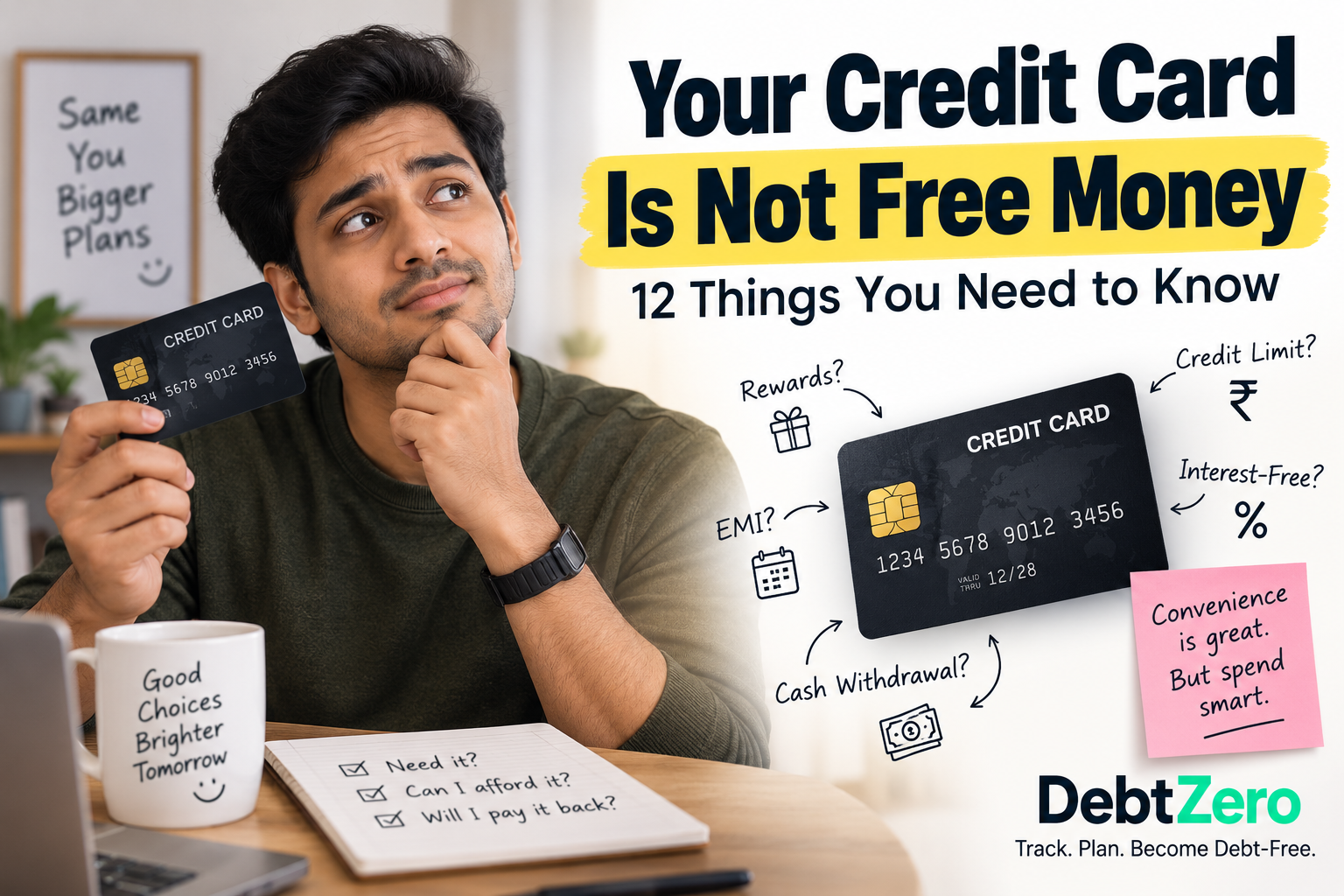
Ravi is 26, earns ₹80,000 a month, and just got approved for a credit card with a ₹2,00,000 limit. The bank calls it "pre-approved." His head calls it something else: extra money.
For the first few weeks, the card is magic. Dinner with friends — swipe. A jacket he'd been eyeing — tap. A late-night food delivery order — pay online. None of it hurts, because none of it touches his bank balance. The money doesn't leave. It just... waits.
Then the statement arrives.
Somewhere between "I'll pay it later" and "wait, how did I spend this much," a lot of first-time and casual cardholders in India cross a line they didn't even know was there. Not because they're bad with money — but because nobody ever explained what a credit card actually is: not extra income, not a bonus limit, not "free money" — a short-term loan that arrives disguised as convenience.
This article isn't about escaping credit card debt — DebtZero already has detailed guides for that. This one is about never getting there in the first place. Twelve things to understand about how your credit card actually works, before the swipe becomes a bill you didn't see coming.
What Is Credit Card Awareness?
Credit card awareness means understanding that every credit card transaction is borrowed money you're committing to repay — not income, and not an extension of what you actually own. It's the habit of checking your ability to pay before you swipe, tap, or pay online, rather than only checking it after the statement arrives. It's the difference between using a credit card as a payment tool and accidentally using it as a second, invisible source of income.
1. Your Credit Limit Is NOT Your Budget
These four things sound similar but are completely different, and mixing them up is where most credit card trouble starts:
| Term | What It Actually Means |
|---|---|
| Income | What you actually earn — the only real source of money you have |
| Bank balance | What's left in your account right now, after this month's expenses so far |
| Credit limit | The maximum the bank is willing to lend you — not money you own, and not a reflection of what you can repay |
| Affordable spending | Income, minus your fixed commitments, minus what you want to save — the only number that should actually guide a purchase |
Take a simple example: salary ₹80,000, credit limit ₹2,00,000. The bank isn't saying "you can afford ₹2,00,000 worth of spending." It's saying "based on our own risk assessment, we're willing to lend you up to this much if you ask." Those are very different statements — one is about your finances, the other is about the bank's comfort with risk. Only you know which number actually fits your budget, and it's almost never the credit limit.
2. Every Swipe Creates a Future Payment
With cash or a debit card, the psychology is simple: money leaves your account now, and you feel it now. A credit card breaks that link on purpose. The purchase happens now; the payment happens later. That gap is exactly what makes cards feel painless — and exactly what makes it easy to lose track of how much you've actually committed to.
Here's how quickly it adds up when nothing individually feels big:
- Food delivery — ₹799
- Online shopping — ₹1,499
- A subscription renewal — ₹499
- An online purchase — ₹2,500
- A restaurant bill — ₹1,200
3. "I'll Pay It Next Month" Is Where Problems Start
The trap isn't any single purchase — it's the pattern. Spend on the card → postpone the payment mentally → spend again because the bank balance still looks fine → the bill arrives bigger than expected → less of next month's income is actually free, because part of it is already owed to last month's spending.
Repeat that cycle a few times and your disposable income keeps shrinking even though your salary hasn't changed — you're just perpetually paying for last month while spending for this one. This is the same underlying behaviour that eventually leads people toward the minimum-due trap, where the bill feels "handled" while the real balance quietly keeps growing. Left unmanaged long enough, this is exactly how ordinary spending turns into revolving credit card debt.
4. Understand Your Billing Cycle
Two dates matter on every credit card, and confusing them is a common, avoidable mistake:
- Statement/billing date — when the bank closes out that month's purchases and generates your bill
- Payment due date — the deadline to pay, usually some days after the statement date
A simple example: if your billing cycle runs from the 6th of one month to the 5th of the next, and your due date is the 25th, then something you buy on the 3rd falls into the bill that's due soon — but something you buy on the 8th won't appear until the following statement, giving you a much longer runway before it's due. Two purchases of the same amount, made just five days apart, can have very different payment timelines. Your exact statement date, due date, and cycle length are set by your card issuer — check your card app or statement to know yours precisely.
5. Interest-Free Does Not Mean "Everything Is Free"
Credit cards can offer an interest-free period on purchases — but usually only when you pay your entire statement balance by the due date, not just part of it. Pay less than the full amount, and many cards start charging interest on the outstanding balance, sometimes from the original purchase date rather than the due date. This is a detailed topic with real numbers involved, so rather than repeat it here, read our full breakdown of how credit card interest actually works in India, and use our credit card interest calculator to see exactly what a partial payment would cost you. The terms — grace period length, when interest starts, how it's calculated — differ by card and issuer, so always check your specific card's current terms and conditions.
6. Rewards Can Make You Spend More
"I'm getting cashback, so this is basically a good deal" is one of the most common — and costly — thoughts in credit card spending. Cashback, reward points, discounts, lounge access, and promotional offers are all designed to make a purchase feel smarter than it is. But the math doesn't change: spending ₹10,000 to earn ₹200 in rewards is still spending ₹10,000. You didn't save money — you spent it, with a small discount attached.
The rule worth remembering: rewards are a nice bonus on spending you were already going to do. They should never be the reason you buy something you didn't actually need.
7. EMI on Your Credit Card Doesn't Make the Purchase Cheap
A ₹30,000 purchase converted to EMI can be shown to you as "just ₹2,xxx a month" — and that framing works, psychologically. A large, uncomfortable number becomes a small, easy one. But the total commitment hasn't shrunk; it's just been spread out, and you're now locking in a slice of every future month's income, often with processing fees or interest added on top.
This deserves its own detailed comparison rather than a repeat here — see our complete guide on converting credit card outstanding into EMI for when it genuinely makes sense and when it doesn't.
8. Cash Withdrawal From a Credit Card Is Different
Withdrawing cash on a credit card is usually treated very differently from a regular purchase — often with its own charges, and interest that can start accruing immediately, without the interest-free window a normal purchase might get. Exact fees and terms vary significantly between card issuers, so we won't quote universal numbers here — check your specific card's terms before you withdraw. As a general habit: don't treat your credit card like an ATM unless you've actually read the cost of doing so. If you're withdrawing cash for a genuine emergency, it's worth comparing the real cost against a personal loan vs credit card in an emergency before deciding.
9. Multiple Credit Cards Can Hide Your Real Spending
Each card bill looks manageable on its own — that's exactly the problem.
| Card | Outstanding |
|---|---|
| Card A | ₹8,000 |
| Card B | ₹12,000 |
| Card C | ₹6,000 |
| Total across all cards | ₹26,000 |
Mentally, these can feel like three separate, small problems. Financially, they're one ₹26,000 commitment due out of the same monthly income. The habit that protects you here isn't checking each card bill — it's checking your total outstanding across every card, every month, in one place.
10. A Credit Card Can Be Useful — If You Use It Correctly
None of this makes a credit card a bad product. Used well, a credit card genuinely helps: it's convenient for online payments, it can offer real rewards and purchase protection, it gives short-term payment flexibility, and where applicable, responsible usage can support a healthier credit history over time. Cards aren't the problem — unawareness is.
The one condition that makes all of these benefits worth it: your spending stays within what you can actually afford, and you can comfortably handle the bill every single time it arrives. Remove that condition, and every benefit above gets outweighed fast.
11. The Credit Card Test: "Could I Pay This From My Own Money?"
Before any non-essential swipe, ask yourself one honest question:
If the answer is no, the credit card isn't making the purchase more affordable — it's just making it feel more affordable, which isn't the same thing. A second question worth adding: "Will this purchase still fit comfortably into my next payment cycle?" If you're not sure, that uncertainty is itself the answer.
12. The One Credit Card Rule to Remember
Before You Swipe: A Credit Card Awareness Checklist
Save this. Run through it before any non-routine credit card purchase:
- Do I actually need this?
- Could I afford it without borrowing?
- Do I know when this purchase will appear on my statement?
- Can I comfortably handle the payment when it's due?
- Am I buying this mainly because of cashback or rewards?
- Will this push my total card spending too high this cycle?
- Do I already have other card balances I haven't accounted for?
A Realistic Indian Example: Rahul's Month
Rahul earns ₹80,000 a month. His fixed monthly commitments already take up most of his income:
| Expense | Amount |
|---|---|
| Rent | ₹18,000 |
| EMIs | ₹15,000 |
| Groceries/utilities | ₹12,000 |
| Family expenses | ₹8,000 |
| Other regular expenses | ₹7,000 |
| Total fixed commitments | ₹60,000 |
That leaves ₹20,000 of genuinely disposable income for the month. Here's what he puts on his credit card instead of paying from his bank balance directly:
| Credit card spending | Amount |
|---|---|
| Shopping | ₹5,000 |
| Food delivery | ₹3,500 |
| Entertainment | ₹2,000 |
| Online purchases | ₹4,500 |
| Miscellaneous | ₹3,000 |
| Total credit card spending | ₹18,000 |
In the moment, this ₹18,000 barely registers — Rahul's bank balance looks fine all month, because none of it left his account directly. It's within his ₹20,000 disposable budget, so it doesn't even feel like a stretch.
But next month, that ₹18,000 becomes a real bill sitting on top of his usual ₹60,000 in fixed commitments — ₹78,000 already spoken for out of an ₹80,000 salary, before he's spent a single rupee on anything new. The card didn't make his spending disappear. It just moved it one month forward, quietly shrinking the room he has to breathe next month too.
How DebtZero Helps You Stay Aware of Your Credit Cards
Most people don't overspend on credit cards on purpose — they lose track, because tracking multiple cards, due dates, and outstanding balances by memory (or across scattered bank SMS alerts) is genuinely hard. DebtZero is built to remove exactly that friction.
- Credit Card Tracking — add every card you hold and see its outstanding balance and due date in one place, not scattered across statements.
- Income & Expense Tracking — see what you actually earn and spend, so "affordable spending" is a real number, not a guess.
- EMI & Overall Debt View — every loan and EMI alongside your credit cards, so you see your complete monthly commitment, not just one piece of it.
- Debt-to-Income Position — understand how your total obligations compare to what you earn.
- Financial Score — a single number that reflects your overall financial health, so drifting in the wrong direction shows up early.
- AI-Powered Logging — instead of filling out forms, just type or speak something like "I spent ₹3,500 on my credit card" and it's tracked instantly.
None of this replaces your own judgment at the point of purchase — but it means the next time you check, you're looking at your real, total picture instead of one card bill at a time.
Frequently Asked Questions
Conclusion: Awareness Now Beats Damage Control Later
A credit card isn't the villain here. Used with awareness, it's genuinely one of the more convenient financial tools available — instant payments, purchase protection, rewards on spending you were doing anyway. The trouble only starts when a high limit gets mistaken for available money, and "I'll handle it next month" quietly becomes a habit instead of a one-off.
You don't need to give up your card or fear every swipe. You just need to keep asking one honest question before you use it: could I pay this from my own money today? If financially disciplined people have one thing in common, it's that they've made peace with paying in full, every time — it's exactly why financially smart people avoid ever paying credit card interest in the first place.
Don't Wait Until Your Credit Card Bill Becomes a Problem
Start tracking it while it's still manageable. DebtZero brings your credit cards, loans, income, and expenses into one clear view.
- 💳 Track every credit card, balance, and due date in one place
- 🤖 Just type or speak: "I spent ₹3,500 on my credit card"
- 📊 See your total debt-to-income position, not just one bill
- 📈 Financial Score to track real progress over time
- 💳 ₹200 to download, then 30 days free access
Track. Plan. Become Debt-Free.
📱 Download DebtZero — ₹200